

The digital backbone to scale your solar finance business
Odyssey provides leading technology and credit solutions to scale solar financing.

Odyssey provides leading technology and credit solutions to scale solar financing.

Odyssey’s supply chain credit bridges permanent/long-term finance, together offering customers a complete financing package.


De-risk each stage of solar finance with the only software dedicated to digitizing and standardizing solar finance.
Streamline origination and due diligence to process applications faster and at lower cost.
Collaborate with project sponsors through customizable workflows, data modules, and interactive data rooms.
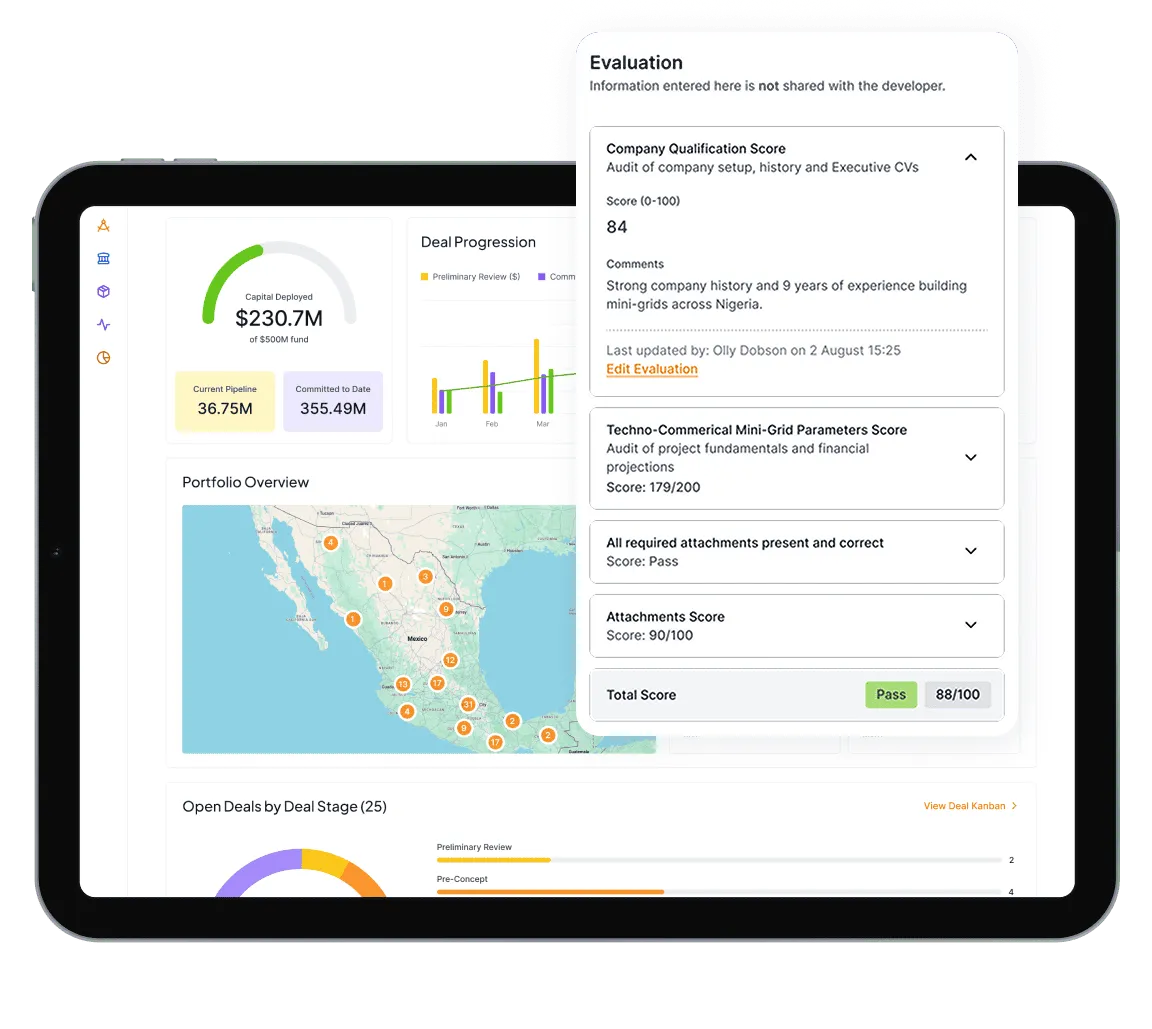
Simplify and standardize due diligence and credit underwriting with digital scoring matrices.
Filter and then aggregate smaller projects into portfolios with automated financial model and benchmarking tools.
De-risk the construction phase with real-time updates and equipment credit from Odyssey.
Access real-time updates to ensure on-time project delivery, within budget, and according to quality and safety standards.
Complement bank financing with Odyssey’s construction credit for EPCs: equipment credit for qualified EPCs for fast and transparent procurement of tier 1 modules, inverters, and batteries.

Monitor each project or portfolio of projects post-commissioning with automated reporting and customized data feeds.
Access real-time performance updates through live system monitoring to ensure financial compliance and address potential issues early.
Simplify portfolio supervision with customized borrower and investee reporting modules.
Manage compliance through interactive file upload tools with automated reviews, document tracking, and notifications.


.webp)
Odyssey finances the construction phase, allowing financiers to disburse loans once the asset is operational.
Aggregate data across all assets via API or hardware and automate reporting on key commercial asset performance metrics.

System performance, utilization, outages against standard values (e.g. kWh, kW, kVA, kVAr), load profile, voltage, current, power factor, performance ratio, and more.

Actual vs planned opex, actual vs. planned savings, actual vs. planned billing, and more.

Leverage, liquidity, and solvency ratios; portfolio breakdown by internal credit rating, geography, borrower, offtaker type, etc.

CO2 avoided, cumulative energy savings, outage hours avoided, jobs created, capital mobilized, % funding in disadvantaged communities, etc.