At Odyssey, we build the infrastructure behind the infrastructure, making it possible for energy program designers to measure the outcomes of their work. We believe that accurate data is key to the success and scale of energy programs. We also know that energy access is not gender-neutral. According to ESMAP, “Poverty reduction, shared prosperity and growth cannot be achieved without reducing gender disparities, or without universal access to reliable modern energy, such as clean energy for cooking, and household access to electricity.”
That is why we build gender tracking into the core of the programs we support, from the first sale to long after the appliance is switched on. This article provides an in-depth look at how Odyssey supports programs to measure gender outcomes and shares some examples of programs who have used these capabilities to have impact.
Why tracking gender outcomes in energy access matters
Women carry a disproportionate share of the burden of energy poverty. On current trends, 341 million women and girls will still lack electricity in 2030, 85% of them in Sub-Saharan Africa. Women also face steeper barriers to owning productive assets, accessing credit, and growing businesses.
The data needed to fix this is often missing. SDG 7 is one of six Sustainable Development Goals with no gender-specific indicators. Without that data, programs risk three things:
- Missing women entirely. A household connection tells you little about who in the household benefits, or who runs the business the power supports.
- Designing blind. Subsidies, financing terms and marketing that ignore gender can reinforce existing gaps.
- Under-reporting impact. Funders increasingly ask for gender results. Programs that cannot show them struggle to attract the next round of capital.
Good gender data shows funders where their money is working, helps companies reach new customers, and lets programs adjust in real time to have greater impact.
How Odyssey helps programs measure gender outcomes
Odyssey's platform is used by governments, development finance institutions and foundations to run results-based financing (RBF) and grant programs across solar home systems, mini-grids, productive use of energy (PUE) appliances and clean cooking. Gender tracking is built into that workflow in three ways.
1. Tracking the gender of every end user, at point of sale and over time
Programs can require companies to report end-user gender as part of each claim, alongside serial numbers, customer names and payment details. That data is captured at the point of sale, so every verified connection or appliance carries a gender record from day one.
Tracking does not stop at the sale. Programs can collect follow-up surveys months later, and pull usage data directly from appliance APIs and company CRMs. This shows not just who bought a product, but whether women kept using it and what changed in their lives and livelihoods.
2. Dashboards built for gender results
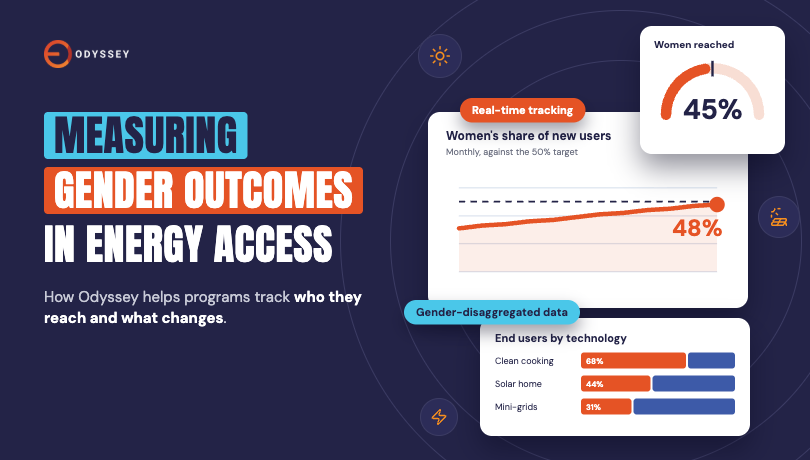
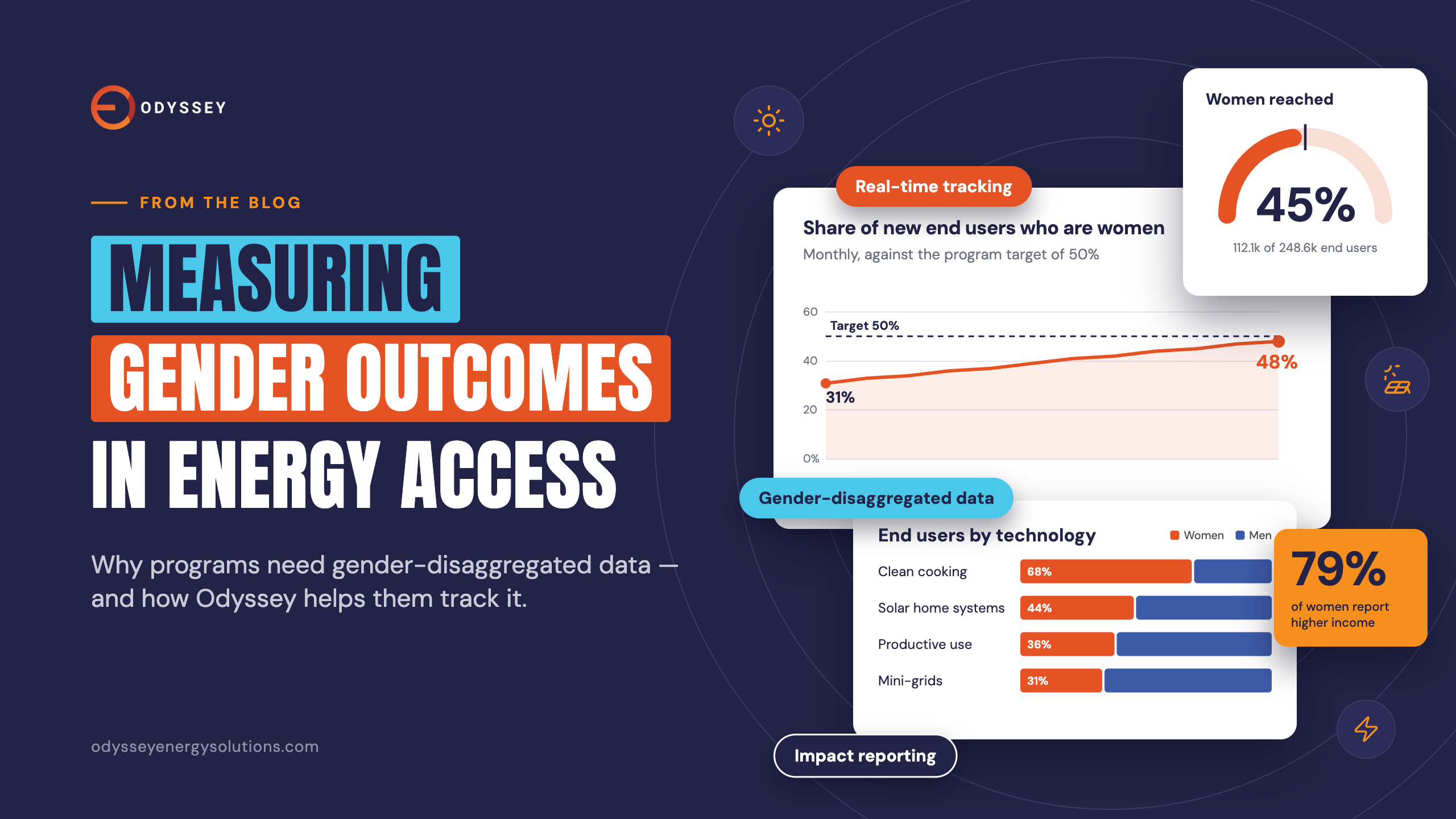
Gender data is only useful if people can see it. Odyssey provides dashboards that show gender-disaggregated results in real time: how many women have been reached, how that compares to targets, and how results vary by company, region or period. Program managers can spot gaps early and adjust incentives or outreach while the program is still running.
3. Gender by type of energy accessed
Women's experience as the recipient of a mini-grid connection is different from their experience of a solar water pump or a cold storage unit. Odyssey lets programs break down gender results by technology, including mini-grids, solar home systems and PUE appliances. This helps funders understand which interventions do the most for women, and where to put the next dollar.
Programs putting gender data to work
Gender Results-Based Financing for Productive Use Appliances
Funded by Shell Foundation and the UK's Foreign, Commonwealth & Development Office (FCDO), and implemented by CrossBoundary and Odyssey, the Gender Results-Based Financing for Productive Use Appliances pilot was designed around one idea: put appliances that generate income into the hands of women across Sub-Saharan Africa.
The program worked on both sides of the sale. Distributors of clean cooking, agro-processing, cold storage and solar water pumping appliances received incentives to target women exclusively (or groups at least two-thirds women). Women buyers received subsidies of 30% to 60% of the appliance cost, sized to its income-generating potential.
Odyssey's platform ran the program end to end. Distributor APIs plugged directly into the platform to track appliance usage, and companies submitted a survey at the point of sale and another six months later. The platform verified each milestone and automated payments.
The results from the $500,000 pilot were striking:

Some companies temporarily increased sales to women by up to 70% through targeted strategies. Just as important, the pilot produced evidence funders can use to design the next generation of gender-focused programs.
The program also funded technical assistance which helped distributors evaluate how they targeted women with their sales that often led to long-term changes and increased gender outcomes that lasted beyond this short pilot. Some examples were
- Including women in marketing materials, like representing women using their products in sales fliers, having women reading their ads on the radio instead of just men,
- Having more women sales agents, which helped women feel more receptive to purchasing a PUE product. Distributors found that women sales agents were highly successful in terms of sales targets (even more so than their male counterparts)
Let's measure what matters, together
We believe measuring gender outcomes is critical to achieving real, lasting impact in energy access. You cannot close a gap you cannot see.
We would love to work with programs that share this commitment, whether you are designing a new gender-focused RBF, adding gender indicators to an existing program, or looking for new and innovative ways to track how energy changes women's lives over time. Odyssey has the tools to support this type of work.
Get in touch with the Odyssey team to explore how our platform can help your program collect, verify and act on gender data.