
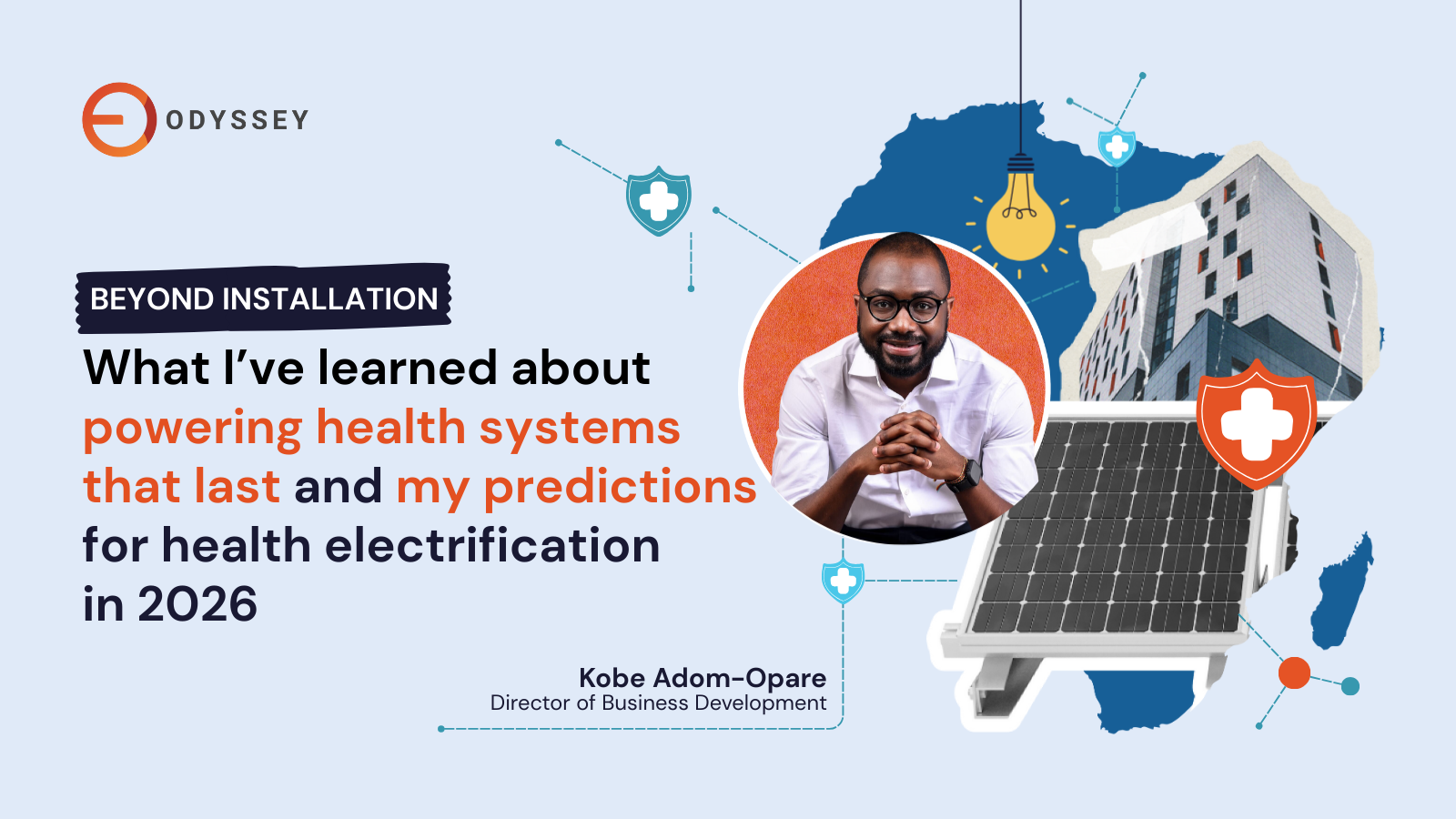
From Installation to Sustainability: Lessons from Sierra Leone
Take a journey with me back to Sierra Leone’s rural clinics, where flickering bulbs tell a story that goes far beyond electricity.
Years ago, while developing the HealthGrid Sierra Leone program with USAID, I visited a small health post equipped with solar panels and storage. The system looked perfect, gleaming under the sun, a symbol of progress. But when I returned just a little over a year later, the lights were out. The problem was not the technology itself. It was everything around it. No maintenance. No budget for ongoing operations.
That experience completely shifted how I see electrification. Installing lights is the easy part; keeping them on, reliably, sustainably, and at a cost communities can manage is the real work. And even when you have good technology, a solid model, and all the right partners at the table, electrifying health facilities is never straightforward. It takes consistent attention, discipline, and resources. Those lessons stayed with me, and they’re a big part of why my work at Odyssey now feels so aligned — we’re solving the exact operational, financial, and data challenges that determine whether systems survive beyond installation.
A 2021 study by the OVO Foundation estimates that every £1 invested in powering health facilities generates between £11.99 and £16.01 in social return. That kind of impact says everything, this is not a “nice to have.” It is essential, and it changes lives.
Building Partnerships That Last
Motivated to find a better way, I started exploring what true sustainability could look like after seeing different models tested and used by various donors and government programs. Working with USAID, Orange, GAVI, RESOLVE, and local partners in Sierra Leone, I led the creation of an unlikely yet powerful alliance. The goal was to bring together telecom companies, donors, and the public sector to share responsibility and risks, pool resources, and keep operations going long after the initial installations.
We developed mechanisms that enabled revenue-generating uses of excess energy from installed systems through water purification and internet connectivity services. We also created an O&M fund that partners could contribute to in order to keep the systems operational. This approach eventually influenced the large USAID HETA program, which, although it later closed after the shutdown of USAID, left a model for collaboration that shaped how energy–health-telecom partnerships can be structured today.
It was not an easy process. Building alliances across sectors takes time and patience. But it proved something important: sustainability in health facility electrification depends on cooperation, not just connection.
Across Africa, thousands of clinics and schools have been powered by solar systems. Yet too many fall into disrepair within a few years because maintenance and data visibility were not built into the design from the start. The lesson from Sierra Leone was clear, installation is only the beginning of the journey.
From the Ground to the Cloud; Scaling Electrification Digitally
When I joined Odyssey in 2022, I began to see the electrification challenge from a completely different angle, through the lens of digital transformation.
If the first part of my journey was about building sustainable systems, the next was about scaling them. Sustainability does not always mean spending more money; sometimes, it is about being smarter. And one of the smartest investments you can make is in sustainable remote monitoring and control.
At Odyssey, we work with governments and development partners to track and manage hundreds of health facilities through a single digital platform. What once required piles of paper reports and expensive site visits can now be seen in real time on a dashboard, performance data, maintenance alerts, and impact metrics all in one place.
When Connectivity Becomes the Challenge
One thing that became clear to me very quickly is that even the most advanced digital tools are only as effective as the connectivity behind them. In our ESMAP-funded remote clinic monitoring work, from Liberia’s forest regions to Burundi’s rolling green hills, the moment the internet drops, our visibility drops with it. Dashboards freeze, data disappears, and teams are forced to fall back on handwritten logs or, sometimes, no logging at all.
So we adapted. We began developing offline-first systems that automatically sync when connectivity is restored. We also added a data backfill query that comes directly from smart meters and inverters, reducing the need for constant manual inputs. These changes allowed even the most remote facilities to be monitored within national systems. And now, the sector is starting to test new backup options like satellite internet for mission-critical facilities, Bluetooth or mesh data loggers for last-mile sites, and high-power connectivity solutions where feasible.
This is why connectivity has become one of the biggest lessons for the future. Internet access will increasingly determine which energy systems thrive and which quietly fail out of sight. If we want public facility electrification to scale, we must treat connectivity as part of the infrastructure itself, not an afterthought. Clinics cannot wait for perfect conditions; we need solutions that reflect the reality of weak, intermittent, or entirely absent connectivity.
Because when visibility improves, accountability follows, and that is what keeps the lights on.
People Power the Systems
One thing I have also learned is that technology alone does not electrify clinics, people do.
Behind every functioning energy system is a nurse who can now safely store vaccines, a technician learning how to troubleshoot an inverter, and a project manager monitoring progress miles away.
That human layer, training, ownership, and local capacity, is what makes systems last. When national agencies like RREA in Liberia take ownership of digital tools and use them to run their own programs, the shift is profound. They move from being beneficiaries of donor programs to leaders shaping their energy futures, although questions of financial sustainability of the systems persist.
The journey is still hard, and financial sustainability remains a challenge. But empowering national agencies is still one of the most meaningful shifts happening today.
What Comes Next, and What We Can Expect to See in 2026
Today, at Odyssey, our work builds on everything these experiences have taught me. We are helping governments and partners go beyond project management, to rethink how programs are designed, embedding transparency, accountability, and sustainability from day one.
Our goal is simple: to make sure every light switched on in a clinic stays on and at scale.
The journey from that first clinic in Sierra Leone to the multi-country digital platforms we now manage at Odyssey has shown me that electrification is not a one-off project, it is a long-term relationship between technology, finance, and people.
As the world accelerates toward universal energy access, the next frontier is integration, where health, energy, and digital systems work together to make clinics not only powered but empowered.
In 2026, I believe we will see:
- Energy-as-a-Service and O&M contract models scaling sustainably across countries like Madagascar, Liberia, Sierra Leone, Kenya, Malawi, and Uganda;
- A shift toward connectivity-aware programming, with governments and donors acknowledging that low or no internet environments require intentional design, not workarounds; and
- A stronger community of African engineers, analysts, and health professionals leading this transformation.
And perhaps most importantly, we need to see more action and fewer delays. Because waiting for “perfect conditions”, the perfect technology, perfect policies, perfect funding mix, risks leaving clinics in darkness for decades.
Clinics need power yesterday. Our responsibility is to maximize the investments made today, starting with making sure systems simply live long enough to reach their natural end of life.
Because in the end, powering health is not about installation, it is about endurance.
It is about ensuring that every watt translates into care, every dashboard into insight, and every clinic light into hope that stays on.
.png)
.png)
